Wonders of the world in 3D
Stonehenge in 3D
Midwinter sunset on the axis
Salisbury Plain, Wiltshire, England
Stonehenge is a ring of standing stones on Salisbury Plain in southern England, raised in stages over about 1,500 years. Its main axis lines up with the midsummer sunrise and the midwinter sunset. Visitors have been kept outside the circle since 1978. In this 3D model you can walk between the trilithons, stand at the Altar Stone and look down the solstice axis to the Heel Stone, then switch to the circle as it stood around 2500 BC.
Key facts
- Where
- Salisbury Plain, Wiltshire, England
- When built
- Built in stages from about 3000 BC; the sarsen circle about 2500 BC
- Size
- The sarsen circle is about 33 m across; the largest stones weigh over 25 tonnes
- UNESCO World Heritage
- 1986
Walk Stonehenge in 3D
A real-time 3D model, built from open elevation data and published measurements. Loads 1.9 MB when you start.
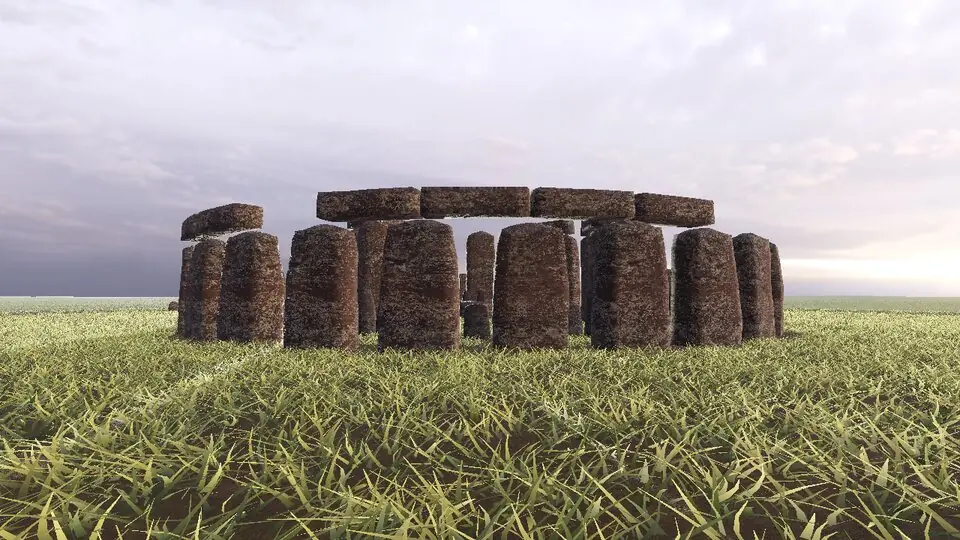
Terrain and sky from open data · stones from published measurements · tags as in the app
Hear the guide
The narrator from the app reads each tour stop. Transcripts below.
-
The Heel Stone
KnownSeen from the centre at midsummer, the sun rises close to this leaning sarsen. At midwinter it sets on the opposite side, down the same axis.
-
The bluestones
KnownThe smaller stones came about 225 km from the Preseli Hills in west Wales, around 3000 BC. Quarry sites have been excavated at Carn Goedog and Craig Rhos-y-felin. How they were moved is still theorised.
-
The trilithons
KnownFive pairs of uprights, each capped with a lintel, stand in a horseshoe open to the solstice axis. The lintels are held by mortise-and-tenon joints: carpentry, done in stone.
-
The Altar Stone
KnownA 2024 study traced this six-tonne slab to north-east Scotland, more than 700 km away.
-
The sarsen circle
KnownRaised around 2500 BC from sarsens brought about 25 km from West Woods. Visitors have been kept outside the circle since 1978. Here you can walk through it.
How to visit in real life
Stonehenge is run by English Heritage. Tickets are timed and booked ahead; a shuttle runs from the visitor centre to the stones, about 2 km away. The everyday path keeps you outside the circle. Inner-circle visits run on a few early-morning and evening dates, and the solstices have open access.
Opening times and tickets change: check the official site. Official site

Open Stonehenge in Farstep
The full site on your phone: a narrated guided tour, passport stamps, offline, and smoother graphics than a browser can give.
- Narrated guided tour, stop by stop, in nine languages
- Passport stamps for every hotspot and finished tour
- Works offline once installed
- Stonehenge free; other sites are one-time packs. No ads, no subscription.
Open in Farstep
On iPhone the button opens the App Store.
Questions
Can you walk inside Stonehenge?
Not on a normal visit: the path keeps visitors outside the circle, and inner-circle access is limited to special booked sessions and the solstices. In the 3D walk on this page you can walk through the circle freely.
Why is Stonehenge aligned with the solstice?
Its main axis runs from the midwinter sunset to the midsummer sunrise, so the builders clearly marked the turning points of the year. What ceremonies took place there is still debated.
More wonders in 3D
Everest summit ridge
Real elevation data · 8,849 m
Grand Canyon
USGS elevation · South Rim
Yosemite Valley
USGS elevation · beneath El Capitan
Avebury
The great henge
Newgrange
Exterior · the mound and kerb
Skara Brae
Neolithic village, Orkney
Callanish Stones
Isle of Lewis
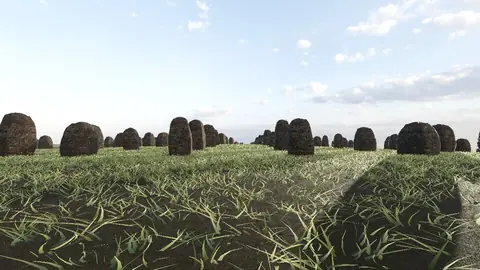
Carnac
The Ménec alignments
Hadrian's Wall
Open LiDAR terrain · Housesteads