Script reference
Old cursive alphabet charts
Five hands account for nearly every page a family historian cannot read. Each chart below draws or sets the alphabet, names the letters that trip modern eyes, says where and when the hand was used, and links to a tool that reads a single cropped word. The same reference is inside the Cursive Lens app, in nine languages.



Kurrent
Old German handwriting, 1500s–1941. Slanted, spiky and narrow.


Sütterlin
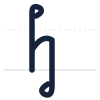
The upright school hand of 1915–1941. Upright, round-topped and evenly spaced, with strokes of one thickness — a tidied Kurrent.


Secretary hand
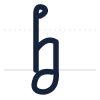
English and Scottish records, 1500s–1700. Angular, with letters that no longer exist in modern writing: a reversed e that looks like a backwards 3, an h that plunges below the line, a c that looks like an r, an r shaped like a 2, and two kinds of s.
Copperplate
English round hand, 1700s–1800s. A steady rightward slant with thick downstrokes and hairline upstrokes, from a flexible pointed nib.
Spencerian
American business hand, 1850–1925. Light, oval and fast, with little shading and long connecting strokes.
Which script is it?
| Script | Years | Where | First tell |
|---|---|---|---|
| Kurrent | From the 16th century to 1941, when it was banned from German schools | Church books, civil registers, letters, diaries and emigration papers from the German-speaking lands, Denmark and Norway | Slanted, spiky and narrow |
| Sütterlin | Designed by Ludwig Sütterlin in 1911 and taught in Prussian schools from 1915, then across Germany in the 1920s and 30s | Letters, postcards, diaries, field post and family papers from roughly 1915 to the 1970s | Upright, round-topped and evenly spaced, with strokes of one thickness — a tidied Kurrent |
| Secretary hand | The everyday English hand from the early 1500s to about 1700, fading as round hand took over | Parish registers, wills and probate inventories, manor court rolls, letters and depositions from England, Scotland, Wales, Ireland and the early American colonies. | Angular, with letters that no longer exist in modern writing: a reversed e that looks like a backwards 3, an h that plunges below the line, a c that looks like an r, an r shaped like a 2, and two kinds of s |
| Copperplate | From about 1700 through the 1800s, taught from engraved copybooks — hence the name | Letters, wills, deeds, ledgers, ship logs and census returns in Britain, Ireland, North America, Australia and the colonies | A steady rightward slant with thick downstrokes and hairline upstrokes, from a flexible pointed nib |
| Spencerian | Taught in American schools and business colleges from the 1850s until the plainer Palmer method replaced it in the 1920s | US letters, diaries, ledgers, county records, Civil War correspondence and the 1850–1920 federal census schedules | Light, oval and fast, with little shading and long connecting strokes |
Crop a single word from your own photograph and get candidate readings with the letter shapes that argue for each. Free, no account, works on a phone.
Questions
- Which script is my document in?
- By date and country, mostly. German-language papers before 1941 are Kurrent (slanted, spiky) or, from about 1915, Sütterlin (upright). English papers before 1700 are secretary hand; from 1700 to the late 1800s copperplate; American papers from 1850 to 1920 Spencerian, and after that the plainer Palmer hand.
- Why can I not read my own grandparents' handwriting?
- Because the alphabet changed. Kurrent and Sütterlin stopped being taught in 1941; secretary hand died out around 1700; copperplate capitals were never part of a 20th-century education. Several letters in each of these hands have no modern equivalent, and until those are learned a page looks like code.
- Are these charts free to use?
- Yes. The Kurrent, Sütterlin and secretary hand letterforms are our own drawings; copperplate and Spencerian are set in two SIL Open Font License faces. Link to the pages freely.
- What does the decipher tool do?
- You crop one word from your own photograph in the browser, say which script it might be, and it returns up to five candidate readings with the letter shapes behind each. It uses the same reader as the Cursive Lens app and is free within a modest monthly allowance per visitor.