
Script reference
Sütterlin alphabet: turning Sütterlin into text
Sütterlin is the handwriting of German letters, postcards, diaries and field post from the First World War to the 1970s — the hand your German grandparents were taught. It is the upright, regularised form of Kurrent, and the same dozen letters cause the same trouble. This chart draws each lowercase letter, explains what sets it apart from Kurrent, and links to a tool that reads a single cropped word.
- When
- Designed by Ludwig Sütterlin in 1911 and taught in Prussian schools from 1915, then across Germany in the 1920s and 30s. Anyone schooled in Germany before 1941 wrote it for life.
- Where it turns up
- Letters, postcards, diaries, field post and family papers from roughly 1915 to the 1970s; school records of the Weimar and Nazi years.
- How to recognise it
- Upright, round-topped and evenly spaced, with strokes of one thickness — a tidied Kurrent. The same letter construction as Kurrent (two-stroke e, bowed u, tall long s) but without the slant or the spikes.
- Letters that fool readers
- The same traps as Kurrent: e against n, u against n (look for the bow), round s against long s. Because it is upright, the loops of h, k and the long s stand out more, and a Sütterlin writer who later learned Latin cursive will mix the two mid-word.
Alphabet
Simplified skeleton drawings by Adelyons, for recognition — not type specimens. The same drawings are in the app's script reference.
Letter by letter
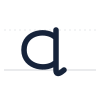 a — A round bowl closed by an upright downstroke. Sütterlin's a is rounder than Kurrent's and rarely mistaken for u.
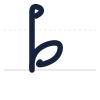 b — An upright looped stroke whose bowl closes at x-height with a short link to the next letter.
 c — A short upright with a hook at the top. Without the hook it is an i; with a dot it is an i — look closely.
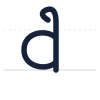 d — The bowl of an a with an upright stroke that curls back to the left at the top.
 e — Two short upright strokes side by side, joined at the top. Still the letter most often read as n.
 f — Tall and crossed, with loops above and below the line.
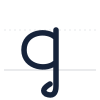 g — The bowl of an a with a looped descender. Compare q, which descends straight.
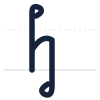 h — A tall looped upright followed by a second stroke that loops below the line. Looks like an f or long s with a tail to an English eye.
 i — A short upright with a dot; a hairline link to the next letter.
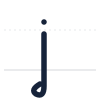 j — An i that descends into a loop.
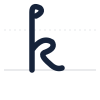 k — A tall looped upright with a small closed loop at x-height on the right side.
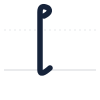 l — A tall looped upright and nothing else.
 m — Three round-topped arches of equal height. Count the strokes in a word like "kommen".
 n — Two round-topped arches. Identical to u except for the bow above the u.
 o — A round oval, the top usually left slightly open with a tiny notch.
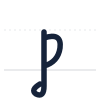 p — A looped descender then an open bowl to the right.
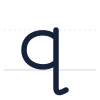 q — The bowl of an a and a straight descender with a small foot.
 r — An upright with a small shoulder to the right at x-height; a flag rather than an arch.
 s — The round (final) s, a compact figure of eight closing a syllable or word.
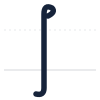 ſ (long s) — The long s (ſ): tall, looped at the top, used at the start and inside syllables. Children were drilled on ſ against s, and most writers kept the rule for life.
 t — A short upright crossed at x-height. In a fast hand the cross is a small hook.
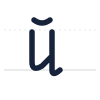 u — Two uprights joined at the foot with a bow above. Without the bow it is n.
 v — An open u-shape closing in a small loop at the right.
 w — Three uprights closing in a loop; compare m, which has arches and no loop.
 x — Two hooked halves back to back; uncommon.
 y — A u whose second stroke descends into a loop; mostly in names.
 z — A 3-shaped letter with a looped descender.
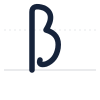 ß — The ß, a tall loop flowing into a round s.
Words to practise on
- Liebe — dear — L tall and looped, the e twice, b with its closing link
- Mutter — mother — bow over the u, two crossed t strokes
- Grüße — greetings — the ß and the umlaut both sit above the line
Crop a single word from your own photograph and get up to five candidate readings with the letter shapes that argue for each. Free, no account.
Questions
- Is Sütterlin the same as Kurrent?
- Sütterlin is a school version of Kurrent introduced in 1911: upright instead of slanted, round-topped instead of spiky, written with a stroke of even thickness. The letter construction is the same, so a reader of one can read the other with a little adjustment.
- Why can't my German friend read Sütterlin?
- It stopped being taught in 1941, and after the war schools moved to a Latin-based script. Germans born after about 1935 were never taught it, so a Sütterlin letter is as opaque to them as to anyone else.
- How do I convert Sütterlin to text?
- Letter by letter with this chart, or photograph the page in Cursive Lens with German as the language hint and correct the transcript against the image. For a single stubborn word, crop it in the decipher tool on this page.
- What does the little bow over the u mean?
- Nothing but "this is a u". Without it the letter would be identical to n, so the bow was taught as part of the letter. It is not an umlaut; the ü has two dots as well as the bow.
- Which records are in Sütterlin?
- Private writing above all: letters, postcards, diaries, recipe books, photograph captions and field post from both world wars. Official registers of the same years are often typed or in Latin cursive, so the private papers are where most families meet it.
About this page
Descriptions are in our own words from the standard palaeography references (the National Archives' palaeography tutorial, the FamilySearch Research Wiki script pages, Süß's and Dülfer's handbooks of German script). Letterforms are ours, as noted above. The same text is in the Cursive Lens app in nine languages. Last reviewed 2026-10-17.