
Script reference
Kurrent alphabet: reading old German handwriting
Kurrent is the handwriting of nearly every German-language record before 1941: church books, civil registers, letters home, emigration papers. It is not a different language — it is a different alphabet for the same one, and once the dozen letters that look nothing like their modern selves are learned, most of a page opens up. This chart draws each lowercase letter, names the ones that fool modern readers, and links to a tool that reads a single cropped word.
- When
- From the 16th century to 1941, when it was banned from German schools. Most German, Austrian, Swiss and Danish records before 1900 are in it.
- Where it turns up
- Church books, civil registers, letters, diaries and emigration papers from the German-speaking lands, Denmark and Norway; also German-American church records into the 1900s.
- How to recognise it
- Slanted, spiky and narrow. Letters are built from pointed up-and-down strokes, so a word looks like a row of sharp waves. The e is two short strokes, the u carries a little bow above it, and the long s (ſ) stands tall while the round s only closes a syllable.
- Letters that fool readers
- e, n and m are all pointed arches: count the strokes (e has two, n two with a rounder top, m three). u and n are the same shape apart from the bow over the u. The h looks like an English f or a long s with a tail. The narrow c, i and the long s are told apart by the dot, the hook and the height.
Alphabet
Simplified skeleton drawings by Adelyons, for recognition — not type specimens. The same drawings are in the app's script reference.
Letter by letter
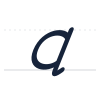 a — A pointed oval closed by a downstroke. Open at the top it reads as u; look for the closed bowl.
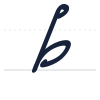 b — Tall stroke with a top loop and a bowl that closes with a flat link at x-height, often read as l or h.
 c — A narrow stroke with a small hook at the top — easily taken for i (no dot) or for the first stroke of an e.
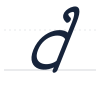 d — The bowl of an a plus a tall stroke whose top bends back to the left. The leftward hook is the tell.
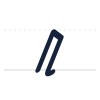 e — Two short pointed strokes close together, the second slightly taller. The most confused letter in the script: it looks like a narrow n.
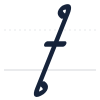 f — Tall, with loops above and below the line and a crossbar — the one letter that crosses both lines with a bar.
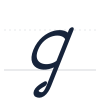 g — The bowl of an a with a descender that loops back to the left. Compare q, whose descender is straight.
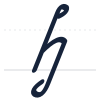 h — A tall looped stroke followed by a second stroke that drops below the line into a loop. English readers see an f or a long s with a tail.
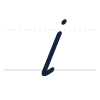 i — A plain short stroke with a dot. Without the dot it is the first stroke of e, n or m.
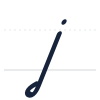 j — An i that descends with a loop to the left.
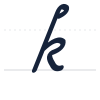 k — Tall looped stroke with a small closed loop at x-height on the right — the loop is what separates it from h and l.
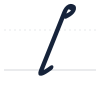 l — A tall looped stroke, no second stroke. Compare h (second stroke), b (bowl) and k (loop).
 m — Three pointed arches. Count strokes: a word like "immer" is a long row of identical spikes, and the count is the only way through.
 n — Two pointed arches with slightly rounder tops than e. Identical to u except that u carries a bow above it.
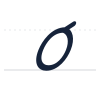 o — A pointed oval, usually with a small open top. Easily read as a or e in a fast hand.
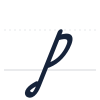 p — A descender first, looped at the foot, then an open bowl on the right.
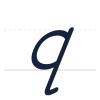 q — The bowl of an a with a straight descender ending in a small foot. Compare g, whose descender loops.
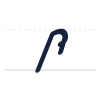 r — A stroke with a small flag or shoulder to the right at x-height. Reads as an unfinished n.
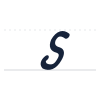 s — The round (final) s, a tight figure of eight closing a syllable or a word: "das", "Haus".
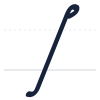 ſ (long s) — The long s (ſ), tall with a loop at the top, used at the start and inside syllables: "ſie", "Haſe". Never at the end of a word.
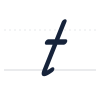 t — A stroke crossed at x-height — short, unlike the tall f. In a hurry the cross is a hook to the right.
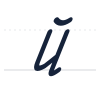 u — Two downstrokes joined at the foot, with a small bow above. The bow is the only difference from n; writers who drop it leave you to decide from the word.
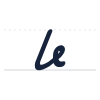 v — An open u-shape that closes with a small loop at the right, often finished with a tail.
 w — A v with one more stroke — three downstrokes closing in a loop. Compare m (pointed arches, no loop).
 x — Two hooked halves back to back, or a crossed pair of strokes; rare, mostly in names and "Axt".
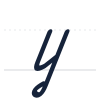 y — A u whose second stroke descends into a loop. Rare in German words, common in names and Greek loans.
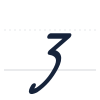 z — A z with a long looped descender, like a 3 with a tail. Compare the round s, which stays on the line.
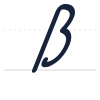 ß — The ß: a tall looped stroke merging into a round s. Older hands write it as ſ + z, which is where the letter comes from.
Words to practise on
- Kirche — church — the K is tall and flourished, the long s is absent, the e twice
- Hauſe — house (dative) — the bow over u, then long s, then e
- Sohn — son — h with its descending loop, n of two spikes
Crop a single word from your own photograph and get up to five candidate readings with the letter shapes that argue for each. Free, no account.
Questions
- What is the difference between Kurrent and Sütterlin?
- Sütterlin is a 1911 school version of Kurrent: upright, round-topped and written with a stroke of one thickness. The letters are built the same way, so a chart for one serves the other. Records before about 1915 are Kurrent; letters and papers from 1915 to the 1940s are usually Sütterlin.
- Is Kurrent the same as Fraktur?
- No. Fraktur is a printed blackletter typeface; Kurrent is handwriting. They were used side by side, and a German document often has a Fraktur printed form filled in by hand in Kurrent.
- How do I tell e from n in Kurrent?
- Count the strokes and look at the tops. The e is two short strokes close together with pointed tops; the n is two strokes with slightly rounder tops and the same height. In practice the word decides: German has far more e than n in the middle of a syllable.
- Why does the long s matter?
- The long s (ſ) looks like an f without a crossbar or like an h. It appears at the start and inside syllables; the round s appears only at the end. Seeing which s a writer used tells you where a syllable ends, which is often how a surname is finally read.
- Can Cursive Lens transcribe Kurrent?
- Yes. Choose German as the language hint and the reader is told to expect Kurrent or Sütterlin and to transcribe into modern German spelling without translating. On this page you can crop one word and get candidate readings for free.
About this page
Descriptions are in our own words from the standard palaeography references (the National Archives' palaeography tutorial, the FamilySearch Research Wiki script pages, Süß's and Dülfer's handbooks of German script). Letterforms are ours, as noted above. The same text is in the Cursive Lens app in nine languages. Last reviewed 2026-10-17.