
Script reference
Secretary hand alphabet: reading Tudor and Stuart records
Secretary hand is the everyday English script of the 1500s and 1600s — the hand of parish registers, wills, inventories, court rolls and letters from England, Scotland, Wales, Ireland and the first American colonies. Its letters are not simply old-fashioned: several of them do not exist in modern writing, which is why a page can look like another alphabet entirely. This guide draws the letters that trip modern readers and shows what each one is, then links to a tool that reads a single cropped word.
- When
- The everyday English hand from the early 1500s to about 1700, fading as round hand took over. Later clerks kept a few of its letters into the 1700s.
- Where it turns up
- Parish registers, wills and probate inventories, manor court rolls, letters and depositions from England, Scotland, Wales, Ireland and the early American colonies.
- How to recognise it
- Angular, with letters that no longer exist in modern writing: a reversed e that looks like a backwards 3, an h that plunges below the line, a c that looks like an r, an r shaped like a 2, and two kinds of s. Words are shortened with superscript letters and strokes through them.
- Letters that fool readers
- e against o and reversed e against 3; c, r and t all made from the same short stroke; the two-stroke a that reads as u; long s against f (the f is crossed); the h with its looped descender mistaken for a y or g; the figure-8 final s read as a letter g.
Key letters
Only the letters that differ from modern writing are drawn; the rest of the alphabet is close enough to read.
Simplified skeleton drawings by Adelyons, for recognition — not type specimens. The same drawings are in the app's script reference.
Letter by letter
 a — Made in two strokes, so it often looks like a u with a closed top or an open o. When the top is left open, the word decides.
 c — A short upright with a hooked head: the same stroke as the r and the t, told apart by the hook, the flag and the crossbar.
 e — The reversed e, a small backwards 3 or a loop with a tail. The single most common letter on the page, and the one newcomers miss entirely.
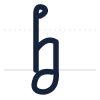 h — Tall at the top, then a great loop that plunges below the line and swings back left. Read as y, g or a flourish by modern eyes.
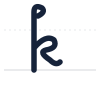 k — Tall, with a closed loop at x-height and a tail — the loop separates it from h and from the long s.
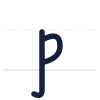 p — The descender is made first and the bowl is left open to the right; it can look like an x with a tail.
 r — The 2-shaped r: a small 2 or z sitting on the line, sometimes with a tail. The upright r also appears, usually after o.
 ſ (long s) — The long s (ſ), tall with a looped descender, used at the start and inside words. It looks like an f without the crossbar.
 s (final) — The final s, a figure of eight or a sickle shape closing a word. Newcomers read it as g, 8 or a flourish.
 t — A short c-shape with a detached cross stroke, often no taller than the vowels. Hard to tell from c when the cross has faded.
 w — Two v shapes with a loop at the start; wide, and frequently decorated.
 y — A v with a long sweeping tail to the left; in "ye" and "yt" it stands for the old letter thorn (th), so "ye" is "the".
 ff — A double f at the start of a word ("ffrancis", "ffarmer") is a capital F, not two letters. Transcribe it as F.
Words to practise on
- Item — the word that opens each line of an inventory — a tall I, a reversed e, a short t and an m
- wyfe — wife — the w, the y with its long tail, a crossed f, a reversed e
- paryshe — parish — the open-bowled p, the 2-shaped r, a long s, a plunging h
Crop a single word from your own photograph and get up to five candidate readings with the letter shapes that argue for each. Free, no account.
Questions
- What is the difference between secretary hand and italic?
- Italic was the humanist hand imported from Italy in the 1500s: rounder, more upright and close to modern letters. Secretary hand was the native working script. Educated writers used both, often italic for Latin and names and secretary for English prose, sometimes in the same sentence.
- Why do old records write "ye" for "the"?
- The y is standing in for the old letter thorn (þ), which printers no longer had. "Ye" is pronounced and transcribed "the"; "yt" is "that"; "wch" is "which". A superscript letter marks an abbreviation.
- What do the strokes through and over words mean?
- Abbreviation. A bar over a word drops a letter (usually m or n); a stroke through a p means par, per or pro; a looped flourish at the end stands for -es or -is. Transcribe the expanded word, or keep the abbreviation and note it.
- How do I read a secretary hand will?
- Start with the formula. Wills open "In the name of God Amen" and move through soul, burial, bequests ("Item I give and bequeath"), executors and witnesses in a fixed order, so the words you expect help you learn the writer's letters before you reach the names that matter.
- Can Cursive Lens read secretary hand?
- Yes: set the era hint to Before 1800 and the reader is told to expect secretary hand, the long s, superscript abbreviations and pre-1752 dating. Check every name against the image — the page editor keeps the line you are correcting next to the ink.
About this page
Descriptions are in our own words from the standard palaeography references (the National Archives' palaeography tutorial, the FamilySearch Research Wiki script pages, Süß's and Dülfer's handbooks of German script). Letterforms are ours, as noted above. The same text is in the Cursive Lens app in nine languages. Last reviewed 2026-10-17.